
An edge score is a composite index that quantifies betting skill by combining calibration, conviction, and discipline into a single percentile-ranked figure between 0 and 100. Sports bettors and analysts use this metric to move beyond raw profit numbers and assess the quality of their decision-making process. Chalkpicks integrates edge score analysis into its AI-powered platform, which has recorded a verified 73.1% win rate and an average ROI of +18.4% over the past year. Understanding what drives this score is the first step toward building a betting strategy grounded in measurable performance rather than guesswork.
What is edge score and how is it calculated?
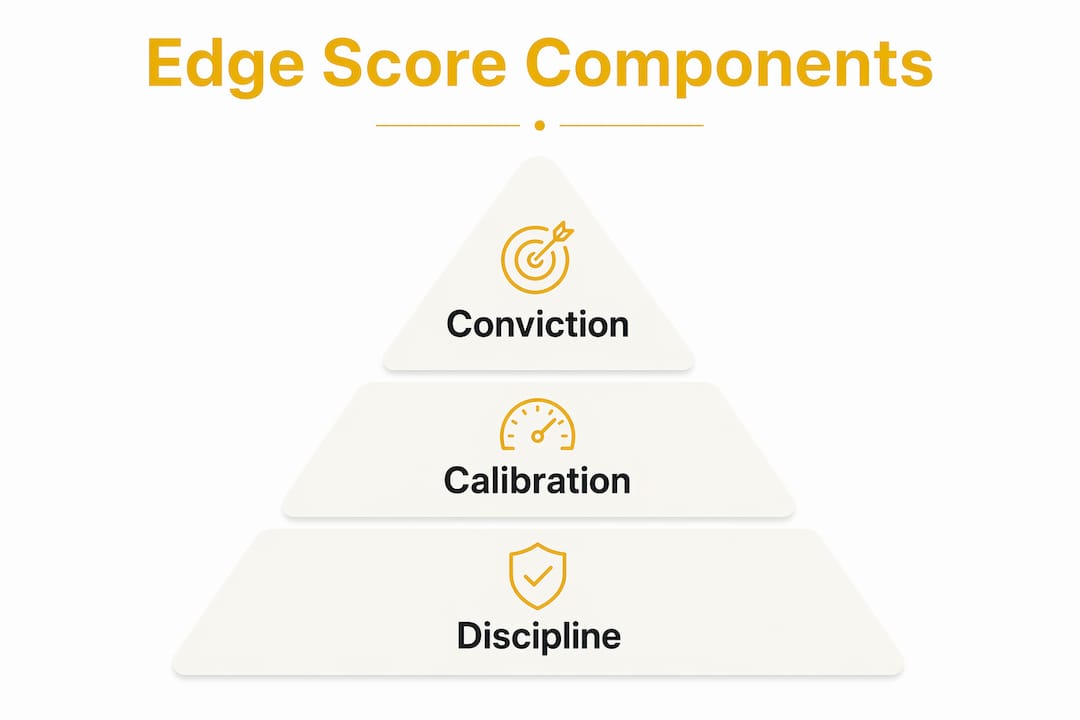
An edge score is a composite skill measure that combines three behavioral pillars into a normalized percentile rank. Each pillar captures a distinct dimension of betting performance that raw profit cannot reveal on its own.
The three core components
- Calibration measures baseline-adjusted accuracy. It compares a bettor's predicted probabilities against actual outcomes, penalizing both overconfidence and underconfidence. A well-calibrated bettor assigns 60% probability to events that win roughly 60% of the time.
- Conviction reflects how concentrated profits are across a selective set of bets. Profitable traders concentrate on a few high-conviction positions rather than spreading capital thinly. The conviction coefficient carries the largest weight in the composite, at +2.72, making it the single strongest driver of a high score.
- Discipline accounts for the number and size of positions taken. High-volume, low-conviction betting dilutes the score even when total profit looks acceptable. Discipline rewards bettors who commit meaningfully to their best opportunities.
Normalization and percentile ranking
Raw scores across these three pillars are converted using z-scores before combination. Normalization prevents raw stats bias and allows fair comparison across different bet types, timeframes, and cohorts. The final figure is a percentile rank within a reference group, so a score of 80 means the bettor outperforms 80% of the comparison cohort.
Pro Tip: Raw profit is an unreliable performance indicator on its own. A bettor who wins $5,000 on 200 low-conviction bets scores lower than one who wins $3,000 on 20 high-conviction bets, because the latter demonstrates repeatable skill rather than volume.
How do edge scores apply to sports betting performance?
Sports analytics platforms apply the same composite logic to player and team performance, offering bettors a richer data layer for pre-game analysis. The J-League model developed by JPick is a well-documented example of this methodology in practice.

Role-specific weighting and momentum
The JPick edge score integrates three signals: baseline contribution, position-specific performance, and recent momentum, updated daily. Each signal carries weights calibrated to the player's role. Saves matter most for goalkeepers. Duels won carry the highest weight for defenders. Goals and key passes dominate for forwards. Position-specific weights prevent a defender from being penalized for not scoring, which is a common flaw in aggregate stat models.
| Signal | What it measures | Update frequency |
|---|---|---|
| Baseline contribution | Season-long average performance | Weekly |
| Position-specific performance | Role-relevant metrics vs. peers | Daily |
| Recent momentum | Form over last 3–5 appearances | Daily |
Recent form carries a gating mechanism. A player who has not met the minimum playing time threshold, approximately 180 minutes, does not receive a stable score. This prevents noise from small samples from distorting the output.
Pro Tip: When using player edge scores for prop bet analysis, filter out any player below the minimum sample threshold. A score built on two appearances is statistically unreliable and should not inform a wager.
Bettors who rely solely on goals scored or win/loss records miss the behavioral and positional context that edge scores capture. A striker with three goals but a low edge score may be benefiting from luck in front of goal rather than consistent quality. The score corrects for that.
What are the limitations of interpreting edge scores?
Edge scores are powerful, but they carry specific limitations that bettors must understand before acting on them.
- Small sample volatility. Scores become unstable when data is insufficient. The 180-minute minimum in sports models exists precisely because small sample sizes cause volatility that misleads short-term interpretation. The same principle applies to prediction market scores: a bettor with fewer than 20 resolved positions has an unreliable figure.
- Relative, not absolute, rankings. Edge score percentile ranks show cohort-relative standing, not guaranteed future returns. A score of 90 means outperforming 90% of the reference group. It does not mean the bettor will profit next month.
- Frozen coefficients. Model coefficients are set on a large reference cohort and do not refit dynamically. This limits forward predictive accuracy, particularly when market conditions shift or a new sport is introduced. Bettors should treat the score as a diagnostic tool, not a forecast.
- Platform variation. Different platforms apply different coefficient weights and reference cohorts. A score of 75 on one platform is not directly comparable to a score of 75 on another. Always interpret scores within the context of the specific model that generated them.
- No guarantee of future profit. The out-of-sample predictive correlation for edge scores in prediction markets is weaker than in-sample results. The +0.514 Spearman rank correlation observed in-sample drops when applied to new data, confirming that the score describes past behavior more reliably than it predicts future outcomes.
The most responsible use of an edge score is as a feedback mechanism. It identifies which behaviors are driving or suppressing performance, giving bettors a structured basis for adjustment rather than a simple verdict on future success.
How can bettors use edge scores to improve their strategy?
Edge scores function best as feedback loops for behavior improvement rather than static success trackers. The practical application follows a clear sequence.
- Identify the top contributing behaviors. Most edge score dashboards display which pillar is driving the score up or down. If calibration is the weakest component, the bettor should review how their assigned probabilities compare to actual outcomes across recent bets.
- Adjust conviction deliberately. Bettors with a low conviction score are spreading capital across too many markets. Reducing the number of active bets and increasing stake on the highest-confidence selections directly improves this pillar. Selective but committed risk-taking consistently outperforms high-volume, low-conviction strategies.
- Monitor discipline metrics over time. Discipline is not just about bet count. It also reflects position sizing. A bettor who places 10 bets but sizes them inconsistently scores lower than one who applies a consistent staking model across the same 10 bets.
- Use updated scores for adaptive strategy. Edge scores updated daily or weekly allow bettors to track whether behavioral changes are producing measurable improvement. Treat each score update as a performance review, not a final grade.
- Integrate with odds comparison and pick analysis tools. An edge score tells you how well you are betting. Tools like Chalkpicks' real-time odds comparison tell you where the best opportunities exist. Combining both creates a complete decision framework.
Pro Tip: Do not increase bet volume to raise your discipline score. The metric rewards quality over quantity. Placing fewer, better-sized bets on high-conviction selections will improve all three pillars simultaneously.
Bettors who use the backtesting tool alongside their edge score data can identify which bet types and markets historically align with their strongest calibration periods. That combination turns a diagnostic score into a forward-looking selection filter.
Key Takeaways
An edge score measures betting skill through calibration, conviction, and discipline, and functions most reliably as a behavioral feedback tool rather than a profit predictor.
| Point | Details |
|---|---|
| Conviction drives the score most | The conviction coefficient (+2.72) is the largest single factor in the composite calculation. |
| Normalization enables fair comparison | Z-score normalization prevents raw stat bias across roles, timeframes, and bet types. |
| Small samples produce unreliable scores | Scores require minimum data thresholds, such as 180 minutes of play, before they stabilize. |
| Scores are relative, not absolute | A percentile rank shows cohort standing, not a guarantee of future profit. |
| Use scores as feedback, not forecasts | Edge scores identify behavioral drivers of performance to guide targeted strategy adjustments. |
The metric is only as good as the bettor using it
Edge scores represent a genuine advance in how bettors can evaluate their own performance. Before composite metrics like these existed, most bettors judged themselves on profit and loss alone, which is a deeply unreliable signal over short periods. The shift toward behavioral metrics is the right direction.
That said, I have seen bettors treat a high edge score as permission to increase stakes dramatically, which is a misreading of what the metric actually says. The score describes the quality of past decisions within a specific cohort and model. It does not account for market shifts, line movement, or the fact that sportsbooks adjust to sharp behavior over time.
The behavioral factors captured by calibration and discipline are genuinely predictive of sustainable betting performance. Bettors who consistently demonstrate high conviction on well-calibrated selections are doing something structurally sound. The score confirms that. What it cannot confirm is whether the next 30 bets will replicate the last 300.
The most sophisticated bettors I have observed use edge scores the way a pilot uses instrument readings: as one layer of a broader decision system, not as the sole input. Pair the score with line movement data, AI-powered pick analysis, and disciplined bankroll management. That combination produces results the score alone cannot deliver.
— WTF69NEWS
Chalkpicks tools that complement your edge score data
Chalkpicks provides a suite of analytics tools built for bettors who take performance measurement seriously. The platform's pick performance analytics tracks win rate, ROI, and behavioral patterns across every bet type, giving bettors the data foundation needed to interpret their edge score in context.

The +EV Finder identifies bets where the implied probability is lower than the actual probability, which directly supports the conviction pillar of any edge score model. Chalkpicks' AI-driven daily picks and Steam Move Detector add real-time market intelligence to the mix. Together, these tools give bettors a complete analytical environment where edge score insights translate into specific, well-timed wagers.
FAQ
What is an edge score in sports betting?
An edge score is a composite index that combines calibration, conviction, and discipline into a single percentile-ranked figure between 0 and 100. It measures the quality of a bettor's decision-making process rather than raw profit alone.
How is an edge score calculated?
The score combines three normalized components: calibration (accuracy of probability assignments), conviction (profit concentration on selective bets), and discipline (number and size of positions). Each component is converted to a z-score before being weighted and combined into a final percentile rank.
Why does conviction carry the most weight in an edge score?
Conviction carries the largest coefficient (+2.72) because profitable betting consistently involves concentrating capital on a small number of high-confidence selections. High-volume, low-conviction strategies dilute performance and reduce score reliability.
Can a high edge score guarantee future profits?
No. Edge scores freeze coefficients on a reference cohort, so they describe past behavioral patterns rather than forecast future returns. The out-of-sample predictive correlation is weaker than in-sample results, confirming the score is a diagnostic tool, not a profit guarantee.
How many bets are needed for a reliable edge score?
The minimum threshold varies by platform and model. In sports analytics models, approximately 180 minutes of play is required before scores stabilize. In prediction market models, fewer than 20 resolved positions typically produces an unreliable figure.